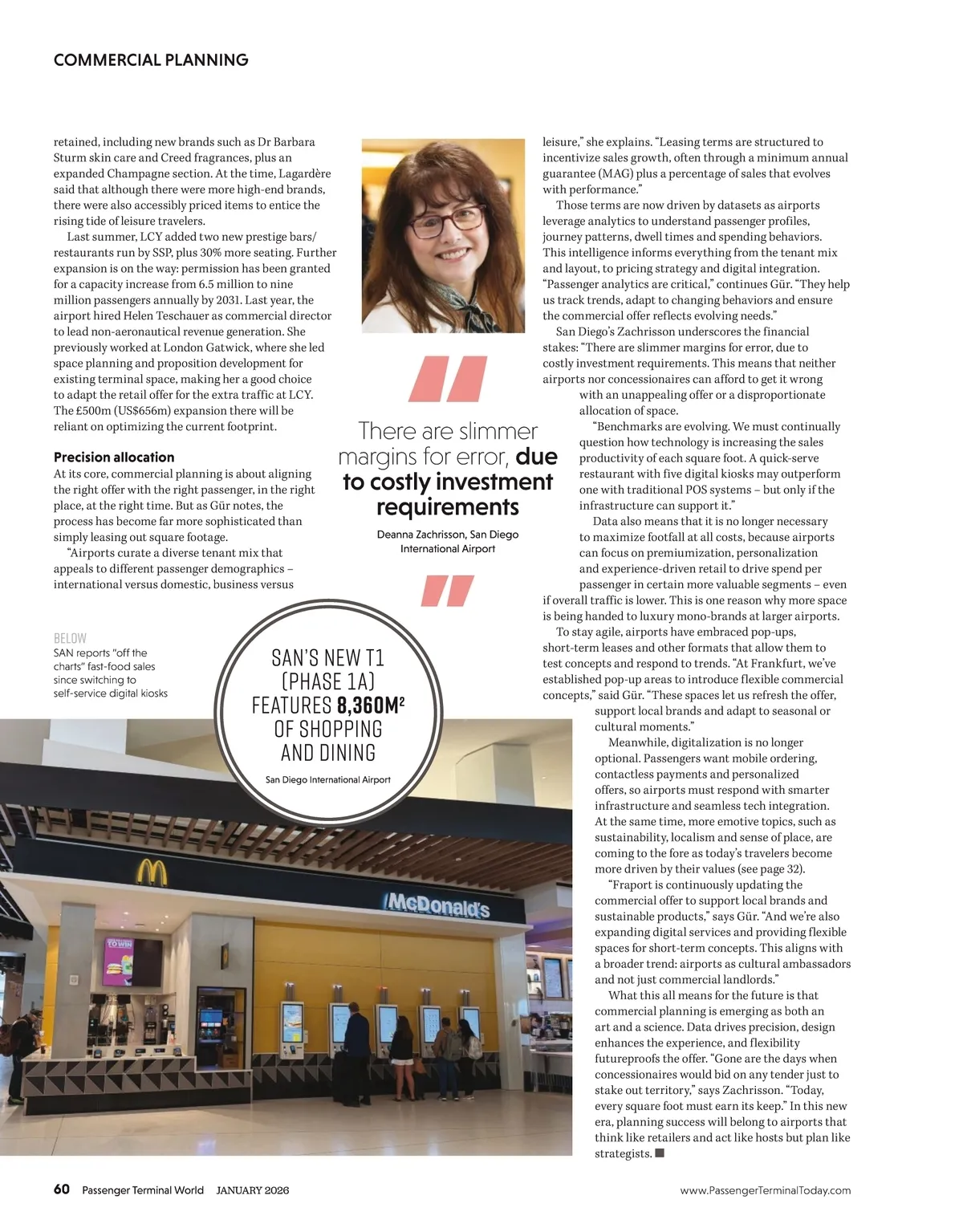
COMMERCIAL PLANNING retained, including new brands such as Dr Barbara Sturm skin care and Creed fragrances, plus an expanded Champagne section. At the time, Lagardère said that although there were more high-end brands, there were also accessibly priced items to entice the rising tide of leisure travelers. Last summer, LCY added two new prestige bars/ restaurants run by SSP, plus 30% more seating. Further expansion is on the way: permission has been granted for a capacity increase from 6.5 million to nine million passengers annually by 2031. Last year, the airport hired Helen Teschauer as commercial director to lead non-aeronautical revenue generation. She previously worked at London Gatwick, where she led space planning and proposition development for existing terminal space, making her a good choice to adapt the retail offer for the extra traffic at LCY. The £500m (US$656m) expansion there will be reliant on optimizing the current footprint. Precision allocation At its core, commercial planning is about aligning the right offer with the right passenger, in the right place, at the right time. But as Gür notes, the process has become far more sophisticated than simply leasing out square footage. “Airports curate a diverse tenant mix that appeals to different passenger demographics – international versus domestic, business versus There are slimmer margins for error, due to costly investment requirements Deanna Zachrisson, San Diego International Airport SAN reports “off the charts” fast-food sales since switching to self-service digital kiosks BELOW san’s new t1 (phase 1A) features 8,360m 2 of shopping and dining San Diego International Airport leisure,” she explains. “Leasing terms are structured to incentivize sales growth, often through a minimum annual guarantee (MAG) plus a percentage of sales that evolves with performance.” Those terms are now driven by datasets as airports leverage analytics to understand passenger profiles, journey patterns, dwell times and spending behaviors. This intelligence informs everything from the tenant mix and layout, to pricing strategy and digital integration. “Passenger analytics are critical,” continues Gür. “They help us track trends, adapt to changing behaviors and ensure the commercial offer reflects evolving needs.” San Diego’s Zachrisson underscores the financial stakes: “There are slimmer margins for error, due to costly investment requirements. This means that neither airports nor concessionaires can afford to get it wrong with an unappealing offer or a disproportionate allocation of space. “Benchmarks are evolving. We must continually question how technology is increasing the sales productivity of each square foot. A quick-serve restaurant with five digital kiosks may outperform one with traditional POS systems – but only if the infrastructure can support it.” Data also means that it is no longer necessary to maximize footfall at all costs, because airports can focus on premiumization, personalization and experience-driven retail to drive spend per passenger in certain more valuable segments – even if overall traffic is lower. This is one reason why more space is being handed to luxury mono-brands at larger airports. To stay agile, airports have embraced pop-ups, short-term leases and other formats that allow them to test concepts and respond to trends. “At Frankfurt, we’ve established pop-up areas to introduce flexible commercial concepts,” said Gür. “These spaces let us refresh the offer, support local brands and adapt to seasonal or cultural moments.” Meanwhile, digitalization is no longer optional. Passengers want mobile ordering, contactless payments and personalized offers, so airports must respond with smarter infrastructure and seamless tech integration. At the same time, more emotive topics, such as sustainability, localism and sense of place, are coming to the fore as today’s travelers become more driven by their values (see page 32). “Fraport is continuously updating the commercial offer to support local brands and sustainable products,” says Gür. “And we’re also expanding digital services and providing flexible spaces for short-term concepts. This aligns with a broader trend: airports as cultural ambassadors and not just commercial landlords.” What this all means for the future is that commercial planning is emerging as both an art and a science. Data drives precision, design enhances the experience, and flexibility futureproofs the offer. “Gone are the days when concessionaires would bid on any tender just to stake out territory,” says Zachrisson. “Today, every square foot must earn its keep.” In this new era, planning success will belong to airports that think like retailers and act like hosts but plan like strategists. www.PassengerTerminalToday.com 60 Passenger Terminal World JANUARY 2026
Passenger Terminal World Passenger Terminal World January 2026: Page 60